ERITREA: Eking out a living in Emkulu
[ This report does not necessarily reflect the views of
the United Nations]
|
© IRIN
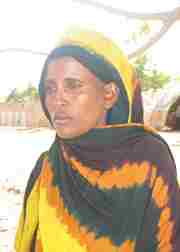
Halima Abdi Adam in the Emkulu refugee camp, near
Massawa |
MASSAWA, 17 Mar 2004 (IRIN) - As the blazing sun
mercilessly beats down on her, Halima Abdi Adam squints and tries to
find some shade under a shrivelled tree.
She is one of over
3,200 Somali refugees who have ended up in the Emkulu refugee camp
on the outskirts of the Eritrean port city of Massawa. She has just
been taking part in festivities to mark the 8 March International
Women’s Day – a welcome diversion from the tedium of daily life as a
refugee.
ON THE MOVE
Emkulu, administered by
the Eritrean Office of Refugee Affairs (ORA), which in turn is
funded by the UN refugee agency (UNHCR), was originally intended as
a transit centre for Eritrean returnees from Sudan. Hundreds of
thousands of Eritreans have been applying for voluntary repatriation
from camps in eastern Sudan which, for many of them, have been their
homes for 30 years since they fled the fighting of Eritrea’s
liberation war.
When hostilities again broke out between
Eritrea and Ethiopia in 1998, however, the Somali refugees, who were
initially in the Assab area, were once more on the move, fleeing
conflict. The Bure front, around Assab, saw some of the fiercest
fighting of the bitter two-year war between the Horn of Africa
neighbours.
"There were 2,300 refugees at the Harsile camp in
Assab," explains Iyob Ghebrenegus, the coordinator of Emkulu camp.
"About 1,300 came here to Emkulu, the rest went to other countries.
They were really on the front line."
Emkulu was established
as a refugee camp in 2000 when the fighting was raging around Assab.
In subsequent years, more and more Somali refugees arrived
spontaneously, many of them having walked hundreds of miles from
Somalia to Djibouti and then into Eritrea.
Halima – the
mother of six children aged between five and 16 - says she fled her
country eight years ago, having witnessed the murder of her father
and brother by Somali militias. At the time, she was living in
Afgoye on the outskirts of the capital, Mogadishu, where law and
order had completely broken down following the ouster of President
Siyad Barre in 1991.
She says civilians were constantly
caught up in the crossfire as rival militias fought for control.
"No-one could live there," she recalls. "We had no choice but to
flee." She arrived in Eritrea - partly on foot, partly by lorry -
via Ethiopia when the border between the two countries was still
open.
Now, she says, she still has no choice. "Beggars can’t
be choosers. We live here with what we have."
Life in Emkulu
can be very difficult because of the harsh climate and relentless
sun. "Life is totally different here," Halima points out. "In
Somalia, I was a person, I had property."
She however says
that even if there was a repatriation she would not choose to
return. She has witnessed terrible atrocities in her homeland and is
too afraid that the events can be repeated over and over again.
"LOWER CLASSES"
Some of the refugees in Emkulu
are from the so-called "lower classes" of Somalia and have always
faced discrimination and marginalisation back home.
Halima is
one of them. She comes from the Midgan or Madiban clan –
traditionally hunter-gatherers, now associated with trades such as
blacksmithing or cobbling. Unlike many of the Somali clans, they
have no geographical area in the country and are scattered
throughout the various regions.
Many of them leave simply in
search of a better life abroad. The ongoing Somali peace process
doesn’t concern them, says one refugee leader speaking in excellent
English. He is a teacher in the camp.
Even if the sides make
peace and an interim charter is adopted later this month, it will
not change anything for the Midgan – a term, he says, is used
pejoratively by Somalis to describe his clan. The peace process in
Somalia has to go way beyond agreement between the major clans; to
succeed, it must also usher in a climate of equity for all Somalis.
Otherwise, there will never be any point in going back, he
adds.
Late last year, UNHCR and ORA began registering
refugees in the country, some of whom had been in Eritrea for 10
years, leading many to believe that repatriation was in the offing.
UNHCR said at the time that the new data would enable the Eritrean
government and the agency to better tailor assistance and protection
to the refugees’ needs. The refugee agency also acknowledged that it
would take a closer look at options for voluntary repatriation to
certain areas of Somalia deemed safe for return.
Eritrea has
no legislation governing the issue of refugees, but it has
accommodated refugees arriving at its borders and respects the right
of "non-refoulement", meaning no forced returns. The country grants
the right of prima facie recognition to groups of refugees.
STAMPING OUT FGM
Meanwhile in Emkulu, ORA and
UNHCR are providing the tools to help the refugees help themselves
through a community services section.
In the camp,
blacksmiths forge the tools needed for everyday life, seamstresses
are provided with training and sewing machines so that they can then
sell the products they make, teachers are sent to Asmara university
for refresher courses, women are trained as midwives and receive
certification to deliver babies safely in the
camps.
Interestingly, these women refuse to perform
traditional female circumcision or female genital mutilation (FGM)
in the camp.
"We have to stop this practice," says Ambia
Salad Hassan, proudly displaying her certificate, signed by the
Eritrean government and UNHCR, which registers her credentials as a
midwife.
She says the most difficult deliveries are among
women who had earlier been circumcised. "We do not perform
circumcision in the camp," she stresses. "We are fighting against
it, with the help of the teachers who can educate the
people."
But, she admits, the women still face a lot of
opposition from the proponents of traditional circumcision. "Our
husbands think that if we are not circumcised, we just go around
with every man," she says.
Ambia and her fellow midwives
stress the need for a campaign, supported by international players,
if the practice is to be stamped out.
[ENDS] |
|
